• The Fever Cabinet
  • Whitetooth Falls
    • Yellow Locust
    • Iron Circle
  • Other Work
  • About the Author
  • Justin Reads
  • Contact
Menu

Justin Joschko

Street Address
City, State, Zip
Phone Number
Author of Yellow Locust

Your Custom Text Here

Justin Joschko

  • The Fever Cabinet
  • Whitetooth Falls
  • Yellow Locust Series
    • Yellow Locust
    • Iron Circle
  • Other Work
  • About the Author
  • Justin Reads
  • Contact

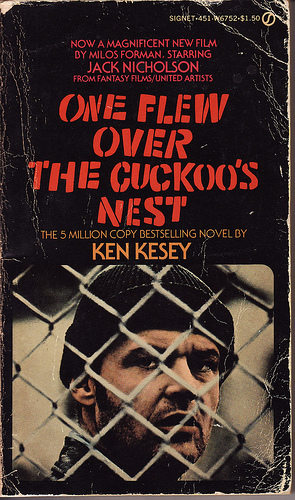
One Flew Over the Cuckoo's Nest - Ken Kesey

August 4, 2019 Justin Joschko
One Flew Over the Cuckoos Nest.jpg

I first read One Flew Over the Cuckoo’s Nest when I was maybe 19. It made a strong impression on me at the time, and remained at the back of my mind as an example of a Great Novel. Picking it up again at 33, I realised how much of my recollection was on the broad strokes of the plot, and on Randle Patrick McMurphy as a character. McMurphy is a solid character, a prototypical 60’s system-bucking hero, and it’s not surprising that we would become the focal point of the novel for most readers. But as I read through the book a second time, I found my attention drifting more and more to the narrator, Chief Bromden.

Books like Cuckoo are written in what we creative writing workshop dorks call “first person pedestal.” This means that the narrator is a character in the story, but unlike a standard first person novel, the narrator and the hero are not the same person. First person pedestal works to give an intimate portrait of an exceptional person from someone who knows them well, but whose own light shines a little less brightly. The Great Gatsby and To Kill a Mockingbird are probably the two most famous examples. Cuckoo is another.

But while Nick Carraway and Scout Finch can never match the allure of Gatsby and Atticus, I actually found Chief Bromden to be an even more interesting character than McMurphy. Kesey drops in details of the Chief’s past life with elegant restraint, and paints an evocative picture of his madness. A lesser author would take the fact that he pretends to be a deaf-mute as a simple narrative device and make his thinking otherwise normal, but it is clear that Bromden really does suffer from some sort of psychological ailment, quite possibly schizophrenia. Much of the narrative richness comes from Bromen’s interpretation of emotional states as affected by the Combine, a nefarious mechanism that controls everything it touches. The recurring images of machinery and fog play into common tropes among schizophrenic patients. It is interesting that Bromden’s paranoia seems to heighten rather than obscure his perception—we don’t question that Nurse Ratched controls the ward, even if we don’t take Brmden’s insistence that she does so through a fog machine literally. This device might not be medically accurate, but it makes for very rich prose.

Tags One Flew Over the Cuckoo's Nest, Ken Kesey, literary fiction, Mental Illness, 1962
Comment

Valérian et Laureline: L'Integrale Volume 1 - Pierre Christin and Jean-Claude Mézières

August 2, 2019 Justin Joschko
Valerien Vol 1.jpg

Valérian et Laureline is a long-running French comic book series. I’d only learned of it recently, but it’s apparently quite the institution in Europe, and has served as inspiration to everything from Star Wars to The Fifth Element. Since much of it was published as short stories in serial magazines like Pilote, categorizing it as a book is somewhat arbitrary. The Ottawa Library has it in a multi-volume omnibus format (L’integrale), so that’s how I’m reading it.

Valérien is a spatio-temporal agent from Galaxity, the Earth-based capital of the Terrien Galactic Empire in the 28th century. His job is to travel back in time and prevent temporal paradoxes caused by careless or malicious time travellers. The series is gleefully pulpy in tone, full of technobabble and concepts with no pretense of grounding in physics. I admire hard science fiction for the intricacy of its concepts and its spartan adherence to known laws, but I have room in my heart for the goofy stuff, too, and Valérian et Laureline definitely falls into that camp.

Volume 1 contains three multi-issue stories: Les Mauvais Rêves (Bad Dreams), La Cité des eaux mouvantes (the City of Moving Waters), and L'Empire des mille planètes (The Empire of a Thousand Planets). The first two follow the heroes’ efforts to thwart a rogue spatio-temporal agent Xombul at various points in history (the 11th century and 1986, respectively). The third story shifts to a distant galaxy where spatio-temporal travel is unknown, and Valérian and Laureline act less as time cops than Star Trek-esque explorers.

The plots are messily enjoyable, full of twists and turns, and the dialogue is full of pulpy banter and excessive exposition—a trait that would be irritating in other concept,s but is so fundamental to the pulp sci fi of that era that it becomes part of the fun. There are some funny bits scattered throughout. My favorite is the gag of having Laureline describe her version of past events to Valérien, while the image shows what actually happened. I look forward to Volume 2.

Tags Valérian et Laureline: L'Integrale Volume 1, Pierre Christin and Jean-Claude Mézières, Valérian et Laureline, Science fiction, Comics, Space Opera, 1967-1970
Comment

A History of Psychiatry - Edward Shorter

July 28, 2019 Justin Joschko
A History of Psychiatry.jpg

The premise of Edward Shorter’s A History of Psychiatry is interesting. The brain remains the one piece of human anatomy whose inner workings we have not yet fully understood, and so an overview of our efforts to treat neurological illnesses seems like it would lead down some dark and intriguing alleyways. And so it does. Shorter provides a thorough chronicle of the different stages of psychiatric medicine, from the first efforts to house the mentally ill in asylums to the wonders of modern pharmaceuticals. The description of these phases was interesting, but strangely the least engaging aspect of Shorter’s chronicle was the human element. Shorter treats the book like a Who’s Who of psychiatric history, and the litany of names drone out paragraph after paragraph, each tagged with a brief description of the individual’s accomplishments before stepping aside to make room for the next shout out. Some names reappear pages later, vaguely attributed, leaving you scratching your head and wondering which of the 50 people you’ve just learned about this one is. I can’t fault Shorter for wanting to cite those responsible for psychiatry’s various accomplishments, but a more in-depth study of fewer players would have gone down a lot easier.

The cluttered prose is an inconvenience, but my biggest issue with the book was its editorializing. Shorter admits early on that he has a certain slant, which is admirable, but a history should strive for some level of objectivity. By contrast, Shorter’s preference for some schools of thought over others is apparent throughout the text—every figure associated with biological psychiatry, however slight their contribution, gets a solid 300 words, while major figures of psychotherapy are glossed over. Carl Jung is mentioned perhaps twice, both times in passing, and without any regard to his work or theories.

This editorializing by omission descends into something almost resembling a rant once it reaches the modern day. His dismisses patients with PTSD, anorexia, and moderate forms of depression, anxiety and OCD as little more than whiners who foisted their diagnoses on a hapless DSM committee through political strong-arming. There remains some validity to his criticisms of how the DSM was and is put together, but his cavalier dismissal of serious illnesses—some of which I’ve witnessed firsthand—was pretty gross. He walks this dismissal back in later pages, making it difficult to discern his exact stance on them, but either way the entire final chapter felt far too editorial in tone.

Tags A History of Psychiatry, Edward Shorter, Non-fiction, Medicine, Mental Illness, 1997
Comment

Darkness at Noon - Arthur Koestler (Translated by Daphne Hardy)

July 17, 2019 Justin Joschko
Darkness at Noon.jpg

If I had to describe Darkness at Noon in one word (why would I ever have to do this? It’s not important), I’d call it “brooding.” The book details the imprisonment and confession of Nicholas Rubashov, a member of the communist old guard who has been accused, somewhat arbitrarily, of crimes against the state.

The majority of the novel is set in Rubashov’s cell, where he communicates with his neighbours using a tap code, and the interrogation room, where he undergoes questioning by two men: Ivanov, an old friend who retains some sympathy for him, and Gletkin, a younger man who represents to Rubashov the changing face of the party he helped build. The action briefly flashes to other times and places, mostly through Rubashov’s recollections of events that are being used against him in the accusation.

The story is lean, slow, and meditative, with most of the action occuring inside Rubashov’s head as he reflects on his situation and explores his shifting attitudes towards communism. Koestler’s creates a rich and conflicted character in Rubashov, a man too intelligent to buy the absurdities of communism, yet nevertheless dedicated to the movement and not yet ready to disavow it. At the start of the book, Koestler provides a brief note explaining that Rubashov is a composite of many individuals who were purged during the Soviet show trials of the late 1930s, and this authenticity bleeds into the narrative.

The prose was rich and engaging, full of sumptuous images that chronicle Rubashov’s inner and outer turmoil. It’s worth noting that the English version of the novel is actually a work of translation, despite appearing on the Modern Library’s Top 100 Best English Language Novels of the 20th Century. I imagine it was deemed to qualify because Koestler’s original manuscript (written in German) was lost, and Daphne Hardy’s English translation was the first version to see publication. I question whether it counts, personally, but translation or no, it’s an excellent novel, and the psychological richness of Koestler’s account cannot be denied.

Tags Darkness at Noon, Arthur Koestler, literary fiction, USSR, Communism, 1940
Comment

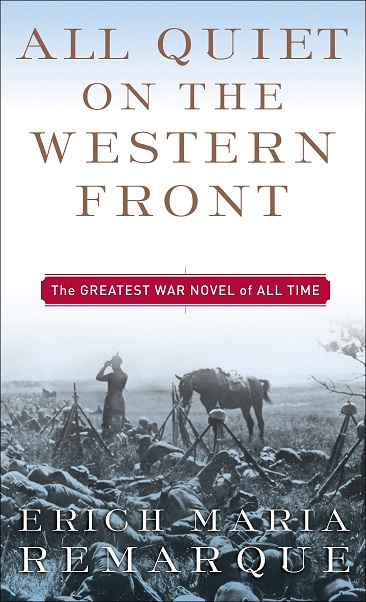
All Quiet on the Western Front - Erich Maria Remarque

July 11, 2019 Justin Joschko
All Quiet on the Western Front.jpg

All Quiet on the Western Front is a story narrated by Paul Baumer, a young German man who, a long with his friends, enlists in the German army during World War 1. No jingoist, he is clearly disillusioned at the opening pages, and becomes only more so throughout. His enlistment, we learn, was largely due to social pressure, personified by an arrogant teacher who bombarded his students with stories of false glory.

The story is episodic, with the only overarching narrative e being the course of the war, which Baumer, as a lowly soldier, barely glimpses. We see through his eyes, and what he sees are generally periods of boredom and hunger punctuated with week-long stretches of terror at the front. Stints on leave and at a military hospital broaden the picture further, giving a cross-section of life as a soldier at that time and place.

The descriptions are frank and horrific without being melodramatic. Indeed, the almost casual way in which Baumer details life as a soldier serves to reinforce the horror of the war. However, the prose isn't always plain, and Remarque allows Baumer the odd poetic digression, without going beyond what a young German intellectual might reasonably say.

All told, the book deserves its reputation as a preeminent work of World War 1 fiction. It's interesting to read as a Canadian with German heritage, as I have relatives who fought on both sides of that conflict. Baumer's reflection on the war's futility, and the perversion of killing men who share more in common with you than the generals and leaders who insist you do the killing, is a simple one, but its truth is profound.

Tags All Quiet on the Western Front, Erich Maria Remarque, Warfare, World War I, Germany, 1928

The Baron in the Trees - Italo Calvino

July 7, 2019 Justin Joschko
The Baron in the Trees.jpg

My god, I wish I came across this book when I was 13. I loved it at 33, and don't doubt I'll love it just as much when I eventually reread it (which I'm sure I will), but I think I would have loved it even more then. And not simply for its content—though as an avid tree-climber it would doubtless have gripped me--but for its melancholic whimsy. It reminds me in tone of Winnie the Pooh and, in a sense harder to define, of Louis Sachar’s Wayside books. Stories that seemed so fully realised that as a child I fell into them, walked about their pages for a while, and emerged at the final chapter ever so slightly changed.

The main character is Cosimo Piovasco di Rondo, who at the age of 12 has a fight with his father over dinner that leads him to climb into the trees and never come down. The story is narrated by his younger brother, who often relies on secondhand information and freely admits that certain passages are supposition on his part--a device that lends both uncertainty and verisimilitude to the story. The rest of the book is an episodic chronicling of Cosimo's life in the trees, with passages both prosaic (his inventive solutions for toiletry, sleep, and commerce) and heroic (battles with pirates and treacherous Jesuits). I loved the former as much as the latter, and the whole story flows effortless as a long campfire fable.

The prose is translated from the Italian, but retains a bit of Mediterranean flavour, evocative but not florid. It avoids the common pitfall of first person narratives where the narrator takes on the cadence of capital N Narration, losing the voice of the person who is supposedly telling the story. I never doubted the voice used here.

Italo Calvino is a name I'd heard for some time but never pursued, knowing nothing about him apart from that he was an author. I found The Baron in the Trees as a fluke, as it was mentioned in the comments of a Guardian article about a man who spent 2 years in a tree. Such happy accidents reinforce the value of always keeping an ear out for new titles. Sometimes the best stories come to you from unexpected places.

Tags The Baron in the Trees, Italo Calvino, literary fiction, Philosophy, Fantasy, Italy, Historical fiction, 1957, Our Ancestors Trilogy

Clock Without Hands - Carson McCullers

June 29, 2019 Justin Joschko
Clock Without Hands.jpg

What a great and burdensome thing it must be, to have written as your debut novel something as immensely powerful as The Heart is a Lonely Hunter. Where do you go from there? How can you compete?

Clock Without Hands is McCuller’s fourth and final novel, written 21 years after Hunter. It opens and closes with J.T. Malone, a middle-aged pharmacist diagnosed with terminal cancer. His remaining lifespan serves as a timeline for the novel, though he quickly recedes into the background of the main story, which instead centers around Judge Clane, an elderly ex-congressman who epitomizes the arrogant bigotry of the Old South, and Sherman Jones, a young blue-eyed black man who was orphaned shortly after birth and carries a large—and not wholly unjustified—chip on his shoulder.

The story builds on the themes of racism and homosexuality that first appeared in Hunter, and while they were less obvious in her first novel (particularly those of homosexuality), their subtlety lent them power. In Hunter, the ruthless racism of the south is shown directly through the visceral descriptions of savagery against Dr. Copeland and his son, whereas in Clock it emerges through the musings of the Judge, who longs for an antebellum era he never actually knew and abhors integration of the races.

However, where a lesser novelist would tumble into saccharine cliche, McCullers strengthens the story by playing against type. Sherman, the black orphan who gets a job as the judge’s secretary, would in a lesser novel be a sympathetic and heroic character. But in Clock Without Hands, he is downright unpleasant—arrogant, rude, untrustworthy, quick to lash out at anyone and everyone. We see his wounds more clearly by what they have made of him, and McCullers makes the more difficult choice of showing that the scars of a hard life, mental and physical, aren’t always attractive.

In mediocre stories, underprivileged protagonists often present with the psychological equivalent of the single scar across the eye favored by rugged action heroes: a disfigurement that lends character and gravitas without damaging handsomeness. The truth, which is at its core the subject of all great literature, is much messier. Often wounded people are hard to be around. We want our underdogs to be polite and heroic, but sometimes politeness and heroics are themselves the result of privilege.

The character of the Judge presents the same idea in reverse: while the novel is unabashed in its implicit criticism of his worldview, and is not above a satiric tone at times, the overall picture it paints is one of pity more than anything. The Judge’s supreme arrogance is pared away and revealed as a hollow varnish painted over a great gaping emptiness. In the book’s closing pages, when he learns of the Supreme Court’s decision to integrate the school system, his final charge for segregation becomes a pathetic farce ,and the last bit of that varnish is torn away. The people in Clock Without Hands are neither heroes nor villains. They’re simply people. And while the story lacks the peerless power of The Heart is a Lonely Hunter, it is nevertheless a strong and moving novel by one of the twentieth century’s greatest novelists.

Tags Clock Without Hands, Carson McCullers, literary fiction, Southern Gothic, 1961
Comment

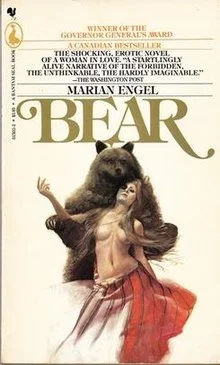
Bear - Marian Engel

June 24, 2019 Justin Joschko
Bear.jpg

I knew Bear by reputation many years before I actually read it, and now that I’ve done so, the controversy that surrounded its publication—already a bit ridiculous on the face of it—seems positively quaint. Only in a place like Canada, where Queen Victoria’s prudish reign hung on in spirit until the final days of the twentieth century, could a novel like Bear be controversial. After all, we’re talking about a book published in 1976—17 years after Naked Lunch, 42 years after Tropic of Cancer, 54 years after Ulysses. If its sole aim was to shock through depiction of sexual debauchery, then it was decidedly too little too late.

Fortunately, Bear’s sole purpose is not to shock. I’m honestly not sure whether that was even among its purposes at all. Its risque subject matter aside, Bear reminds me less of the taboo-probing forbears listed above than of Surfacing, Margaret Atwood’s novel published only a few years earlier in 1972. It’s been over a decade since I read Surfacing, but my thoughts turned in its direction as a read Engel’s novel. Both books feature female protagonists facing some profound but largely unspoken emptiness in their lives, and both venture into the Canadian wilderness in an effort to address it. It is in these wilds that Engel’s protagonist, Lou, meets the eponymous Bear while on an assignment to catalog the possessions of the late Colonel Cary.

What follows is a subtle and often unspoken portrait of loneliness. There are a few short passages with explicit language that strike with surprising keenness amidst the literary prose, but my takeaway from Bear was less the protagonist’s peccadilloes than than the yawning and undefined hunger inside her. It’s a rich story well told, and one deserving of continued appreciation beyond its seamy notoriety.

Tags Bear, Marian Engel, Canadian Literature, literary fiction, 1976

The Interpreters - Wole Soyinka

June 24, 2019 Justin Joschko
The Interpreters.jpg

I often put a hold on books at my library that don't arrive for months, and by the time I get them I don't remember what they are or why I wanted them in the first place. The Interpreters has been a similar experience, only I bought it instead of borrowing it. I don't recall when or why, but I'm glad I did.

The novel concerns a wide-ranging cast of young intellectuals in Lagos, Nigeria. There is little by way of an overarching plot. Instead, stories come and go and cross paths with one another, not in an episodic faction, but rather a fluid and ever-shifting narrative flux. Targets emerge for satire--politics, the news media, universities, religious cults--before dissolving into the textual mists. The result is disorienting, though Soyinka's rich prose and dark humor propel things along.

The book offers little by way of narrative signposts. Characters are introduced with no context for who they are or how they relate to one another, and names take a central role before disappearing for chapters at a time. Egbo opens and closes the novel, and his traumatic memory of seeing his parents drown acts as a thematic bookend, but other characters play a much bigger role in the novel's center. Kabo, the disillusioned painter, is one example. Sagoe, a beleaguered journalist, is another. A few white visitors emerge as peripheral characters, where they serve as both targets of satire in their own right and ammunition aimed at the obsequious treatment they receive by black intellectuals in some circles.

The prose is rich with imagery, the dialogue quick-witted and playful. It reminds me, in a free-association sort of way, of Joseph Heller’s Catch-22. The stories are nothing alike, and the writing styles are different—Soyinka’s more florid and poetic, Heller’s more jokey—but both authors deal with a fluctuating cast of characters, through which they paint a stinging picture of of a community, and through it society at large.

This book is a real find. I just wish I remembered where it was I found it.

(An additional point: none of the characters are interpreters by profession, and no one does any interpreting, so I’m at a loss as to the meaning behind the title. I could probably come up with some sort of symbolic reason, but it would be a guess and probably wrong)

Tags The Interpreters, Wole Soyinka, literary fiction, Nigeria, West African
Comment

The Heart Is a Lonely Hunter - Carson McCullers

June 16, 2019 Justin Joschko
The Heart Is a Lonely Hunter.jpg

There are a handful of books that seem to make in on every “best of” list for 20th century fiction. The Heart Is a Lonely Hunter is one of them. And rightfully so.

Centered around a deaf mute man named John Singer in a Georgian Mill Town, the book slowly expands to encompass a group of characters who are superficially unrelated, but share a profound inner pain that Singer, in some strange way, seems to soothe. Though fundamentally good, Singer is not some beatific healer, but is himself deeply wounded, and seeks his own solace in a friendship with a Greek man named Spiros Antonapoulos. Though their friendship is platonic and there is no hint of romantic affection between the two, their interactions have a subtext of unrequited love, as Singer’s devotion to Spiros is not mirrored by Spiros’ behavior towards Singer. This is not necessarily because Spiros is manipulative or selfish, but more likely from an undiagnosed mental illness or developmental issue. Much remains unspoken and unlearned, which is an accurate reflection of how mental illness was treated at the time.

McCullers’ prose is excellent in a graceful, understated way. She writes in a style I admire in no small part because I can’t emulate it. It takes a special gift to write prose that is lyrical but not ornate, that carries poetry in simple, declarative sentences. Whole paragraphs can pass without a single comma, and her use of metaphor is restrained, giving the few that she uses greater power. The book is a masterpiece.

Tags The Heart Is a Lonely Hunter, Carson McCullers, literary fiction, Southern Gothic, 1940
1 Comment

Bonjour Tristesse - Francoise Sagan

June 14, 2019 Justin Joschko
Bonjour Tristesse.jpg

I encountered this book on recommendation from a friend, who bought me the English translation. However, I make a point of reading French works in the original wherever possible, and fortunately I was able to find a copy at my local library. It would be interesting to pick up the version she gave me and see how it matches up to my interpretation.

Like Nabokov’s Lolita or Salinger’s Catcher in the Rye, Bonjour Tristesse is less about the story it tells than the person telling it. The narrator, a world-weary seventeen-year-old named Cécile, vacations with her father and his young girlfriend Elsa on the French Riviera. Their peaceful equilibrium is shattered by the arrival of Anne, an attractive and intelligent woman who is a friend of the family through her father’s late wife. Her father soon leaves Elsa for Anne, who insists that Cécile show greater ambition for her studies. Cécile, incensed, resolved to break them up.

Aside from a budding romance with a neighbourhood boy, this is about all the plot the book has to offer. As a storyline, it’s pretty trite, but where the book rises above its tropes is in the complex and partially unspoken feelings that Cécile has for Anne. A more straightforward story would paint Anne as the villain, or at least in the wrong, or flip it by making her misunderstood and forcing Cécile to learn the error of her ways. But while Cécile does show regret for her actions, it is the ambivalence of her attitude that makes her intriguing. She slingshots between crushing doubt and steely resolve over and over again.

As a reader, I find first person perspective to be overused and often misapplied, but this is a book that simply couldn’t work any other way. The story only matters because we hear Cécile telling it. Without direct access to the riptide of her adolescent angst. As I learned my French more through reading than conversation, I struggle to pinpoint accuracy in dialogue, and the fact that this book is written in the voice of a French teenager form the 1950s, I am simply too far removed to argue whether or not that it rings true. I can only say that it flows nicely, and that its flights of poetic fancy are modest enough to avoid the pitfall common to first person books, in which the author adopts a tone too elevated to belong to a casual speaker.

Tags Bonjour Tristesse, Francoise Sagan, Francais, France
Comment

Mosquitoes - William Faulkner

June 4, 2019 Justin Joschko
Mosquitoes.jpg

Mosquitoes is the second novel that William Faulkner published, appearing only a year after his debut Soldiers’ Pay. Though it is uncertain which of them was written first, Mosquitoes certainly feels like the sophomore work, as its tone and style place it somewhere between the more straightforward Soldiers’ Pay and the mad rush of stream-of-conscious fervor to come. The story concerns a party hosted by a socialite named Mrs. Maurier, whose fascination with artists leads her to invite various luminaries from the New Orleans literary and artistic scene on a four-day cruise aboard a motorized yacht called the Nausikaa.

Faulkner employs many of the techniques that would become his signatures, including a rich and somewhat archaic diction, bursts of stream-of-conscious writing to underscore moments of great psychological insight or strain, and a tendency to write around key events rather than describing them outright, leaving it up to the reader to infer what happened based on the shape of the hole made by its absence. This technique even extends to the titular insects themselves, who plague the characters on multiple occasions but are never actually mentioned by name (note: this only occurred to me midway through my reading, so it’s possible I missed a mention early on. In any case, he seemed to take pains not to write the word “mosquito,” whatever the reason for that may be)

Another common trait in Faulkner’s work—at least the ones I’ve read—that also appears in Mosquitoes is his tendency to avoid having one character stand out as a clear protagonist. Reflecting on the story, there are a number of candidates for the title: Mrs. Maurier, whose desire to host a gathering for artists launches the entire novel; Mr. Talliaferro, whose presence bookends the novel; Fairchild, a slightly gone-to-pot novelist who seems a focal point for many of the other characters; Patricia, Mrs. Maurier’s niece, whose complex and combative relationship with her aunt and brother drive much of the story’s tension. However, none of these characters feel truly central to the story.

If the book has a key character, it is probably Gordon, the terse and enigmatic sculptor who acts as a source of fascination for many of the other characters, but hardly says or does anything himself. In this way, he is oddly reminiscent of the doomed pilot Donald Mahon in Soldiers’ Pay. While Gordon is a less sympathetic figure, both men cast outsized shadows across the stories they inhabit, where they act more as symbols and foils for the other characters than as characters themselves. It will be interesting to see if this tendency appears in Faulkners’ other books. Certainly the dead mother in As I Lay Dying is a good example of such, though it’s been too long since I read his other work to recall accurately.

Tags Mosquitoes, William Faulkner, literary fiction, Southern Gothic, 1927

The Moviegoer - Walker Percy

May 28, 2019 Justin Joschko
The Moviegoer.jpg

The Moviegoer is one of an assortment of books that I read in my early 20s and of which I retained basically no memory. Lately I’ve made a point of revisiting these books to get a sense of what I missed the first time. In some cases ,such as One Hundred Years of Solitude, I found myself surprised that they left so little an impression at the time. In the Moviegoer’s case, I’m less shocked.

The story, such as it is, concerns a New Orleans stockbroker named Jack “Binx” Bolling, the eponymous Moviegoer, as he passes an indeterminate period of time, primarily in the company of one of two women: his secretary, Sharon, a young Southern girl who has recently moved to the city; and his cousin, Kate, for whom he retains a complex romantic affection that is not exactly reciprocated.

There’s really not much more to say in terms of plot. The novel belongs to one of the more ponderous sub-genres of literary fiction, in which a well-to-do male protagonist in his early middle age undergoes some form of slumming—financial or, as in BInx’s case, intellectual—and Thinks Big Thoughts. It’s not a genre that appeals to me, as I prefer books that hew more towards story or style, and don’t park themselves so squarely in the realm of pure philosophy. It’s an aesthetic preference, and as such not a reflection of the book’s quality or lack thereof, but ti doesn’t change the fact that the story left me pretty cold.

The prose is strong for the most part, with rich imagery and a compelling voice. Percy pulls off a neat trick by having me buy Binx as a character despite the fact that no human being would really talk the way he talks. It’s a pet peeve of mine when authors select a first-person perspective and then write in a grandiloquent style that would have been much better suited to a third-person narrator, and while this decision still rankled on occasion, Percy gets away with it better than some (I’ve had to put down more than one book unfinished for that very reason).

Lastly, I can’t think of The Moviegoer or Walker Percy without acknowledging that he is the person who is second-most responsible for the publication of John Kennedy Toole’s A Confederacy of Dunces (the most responsible person being Toole’s own mother). That buys an awful lot of good will from me, but it also invites an inevitable comparison between the two works, and in any match with Dunces, the opponent is going to come up short.

Tags The Moviegoer, Walker Percy, literary fiction, Philosophy, 1961
1 Comment

Soldiers' Pay - William Faulkner

May 23, 2019 Justin Joschko
Soldiers Pay.jpg

Soldiers’ Pay is the first novel that Faulkner published. It isn’t necessarily the first he wrote—there is uncertainty there—but it is unquestionably among his earliest novel-length works. His most famous novels—the Sound and the Fury, As I Lay Dying, Sanctuary, Light in August—would emerge in a flurry of astonishing literary fecundity a few years down the road. Soldiers’ Pay contains the seeds of these works, and if it is not quite at their level, it is nevertheless an impressive debut.

The story centers around Donald Mahon, a pilot in the First World War who was shot down and grievously wounded. While the story involves Mahon’s journey home and the reception he receives when he gets there, his character is less the nucleus of the novel than a hollow core around which the other characters orbit. Blind, weakened, and largely mute, he acts as a mirror, reflecting the wants and intentions of those around him.

The most prominent of these characters are Joe Gilligan and Margaret Powers, a solider-in-training who never saw combat and a war widow, who take Donald under their wing and shepherd him home. When her arrives, he is greeted with a mixture of joy and horror by his fiance, Cecily Saunders, who feels an obligation to marry him despite her disgust at his appearance, and is at once dismayed by this prospect and attracted by its romantic implications.

The prose is more straightforward than what might be thought as “Faulknerian,” as the more experimental aspects of his writing are used only sparingly. However, hints of the talent more fully unearthed in later works peek periodically through the topsoil. One lyrical passage struck me in particular: “an overcast sky, and earth dissolving monotonously into a gray mist, grayly. Occasional trees and houses marching through it; and towns like bubbles of ghostly sound beaded on a steel wire.”

Soldiers’ Pay is a novel of a developing author, but given who he developed into, it is still well worth reading.

Tags Soldiers' Pay, William Faulkner, Southern Gothic, literary fiction, 1926
Comment

The Devil in the White City - Erik Larson

May 12, 2019 Justin Joschko
The Devil in the White City.jpg

I picked up The Devil in the White City a few months after reading another of Larson’s books, In the Garden of Beasts, which chronicled the experiences of the American ambassador to Germany during the rise of Nazism. I greatly enjoyed that book, and so approached Devil with high expectations—especially as the subject matter was inherently intriguing.

The book follows the stories of two men in Chicago in the 1890s: Daniel Hudson Burnham, the driving force behind the creation of the Chicago World’s Fair; and H. H. Holmes, a conman and, arguably, the prototype for every serial killer to plague the 20th century. I’d heard of Holmes before, and knew a tiny bit about the World’s Fair, but there was plenty more for me to learn about both.

One particular way Larson excels is in titles—a small thing, in a sense, but important. In In the Garden of Beasts, he makes symbolic hay out of the fact that the American embassy in Berlin was located on the Tiergatrenstrasse, which translates to animal garden street—or, more poetically, “the street of the garden of beasts.” Similarly, The Devil in the White City evokes a feeling of infiltration and illusion, the idea that a place of wonder can be the perfect place for something dreadful to hide and fester.

Larson jumps back and forth between the two stories regularly, forming a counterpoint of themes that feels striking without seeming forced. The ideas a presented but not spelled out: light and darkness, creation and destruction. Larson’s prose is richer and more lyrical than you’d expect from a work of historical non-fiction, and he uses a lot of dramatic effects more common to a novel to drive the story forward.

While less exhaustive a chronicle than Beasts, the Devil in the White City is even more compelling in the picture it paints, all the more so in that the story it tells is much less known. The horrors or Nazism have been articulated in a hundred plus novels, movies, and television shows, but the more private atrocities of H. H. Holmes remain largely forgotten, despite the fact that, though on a much smaller scale, they betray an equal lack of basic humanity that underpins our society, and that has shown itself time and time again to be much more fragile than we would hope.

Tags The Devil in the White City, Erik Larson, Non-fiction, 19th Century, True Crime
Comment

The Amazing Story of Quantum Mechanics - James Kakalios

May 3, 2019 Justin Joschko
The Amazing Story of Quantum Mechanics.jpg

There’s a saying that goes, “If someone tells you they understand quantum physics, they’re lying.” There’s probably some truth to that, given how much about the universe is still not understood, but I also think it does a bit of a disservice to non-scientists who might be interested in learning about the basics quantum mechanics, as it suggests that it’ll all just go over their head and is therefore not worth doing. I won’t lie and say that none of what James Kakalios discusses in The Amazing Story of Quantum Mechanics was beyond me, but I will say that, even as a hapless English major, I learned a lot about the basic underpinnings of quantum mechanics and how there theories are applied to the devices I use every day.

I should add that I did have a bit of a primer in the subject, as prior to picking up Kaklios’ book, I read Quantum Theory: a Very Short Introduction by John Polkinghorne. The two works compliment each other nicely. Polkinghorne provides a chronology of the various theoretical breakthroughs that inform quantum theory, and is more technical. Kakalios, on the other hand, avoids a linear approach, and instead highlights select aspects of quantum mechanics in order to explain it’s real-world applications.

The science Kakalios presents is simplified without being excessively diluted, and he employs a number of creative analogies to explain different aspects of quantum physics. Some of these are a little tricky (I needed to read through the orechestra-balcony-mezzanine analogy for semiconductors a couple of times, and would still probably screw it up if I tried to explain it to you now), but given the complexity of the subject, they do a great job.

The real treat of the book is Kakalios’ humour, which I would describe—and I mean this in the nicest possible way—as disarmingly dorky. There’s genuine with beneath the cornier jokes, but also a genuine earnestness that I found endearing. It’s clear that Kakalios knows and loves his subject, and is excited to help more people learn about it.

If your interest is more in the theoretical aspects of quantum physics, Polkinghorne’s book might be more what you’re looking for, but if you’re after a primer that’s fun to read with plenty of real-world examples, Kakalios’ book is for you.

Tags James Kakalios, The Amazing Story of Quantum Mechanics, Non-fiction, Popular science, 2010
Comment

One Hundred Years of Solitude - Gabriel Garcia Marquez

April 23, 2019 Justin Joschko
One Hundred Years of Solitude.jpg

I first read this book about ten years ago, and for some reason it didn’t stick. I could only recall one thing about it in detail: a trail of blood winding its way through a rustic Latin American town. Re-reading it now, I’m surprised more of it didn’t stand out for me, as the story is bristling with rich, poetic images.

One Hundred Years of Solitude is the story of a family, but it’s also the story of a town, as the Beundias and Macondo are inextricably linked. From Macondo’s founding by the Beundia patriarch, José Arcadio, to its foretold destruction, the town holds the Beundia family at its turbulent center, and the fate of one feels reflected by the fate of the other.

The story is complex and roughly chronological, with regular lurches forward and backward in time. The structure creates a sense of disorientation, which increases with the introduction of each new generation, which inevitably takes the names of some or all of its predecessors. There’s some realism to this, as family names are common, but I can’t help but feel that it was also a deliberate choice by Marquez to underscore the cyclical, Sisyphean nature of the family’s struggle. In any case, the profusion of José Arcadios and Aurelianos can be a challenge at times, not least because the family’s prodigious longevity and propensity for becoming ghosts can mean that five or six generations are in the story at the same time.

As with all translated books, I hesitate to comment about the prose, since it comes to me filtered ,but in this case I can only say that it reads beautifully, with lush, loping sentences overflowing with imagery, reaching nearly half a page at times. Bursts of absurdist humour leaven the largely tragic story, which, alongside the vicissitudes of life and death in a hardscrabble rural village, covers such pivotal events as war, political upheaval, and the encroachment of colonialism.

All told, it’s a brilliant book, and one I’m surprised I didn’t connect with more strongly the last time.

Tags Gabriel Garcia Marquez, One Hundred Years of Solitude, literary fiction, Magic realism, South America, Translation, 1967
1 Comment

The Three-Body Problem - Liu Cixin

April 6, 2019 Justin Joschko
Three-Body Problem.jpg

Despite a teenage obsession with Isaac Asimov’s Foundation series, I’ve never been particularly drawn to hard science fiction. As such, I approached the Three-Body Problem without much in the way of expectations.

The story concerns scientists in the People’s Republic of China over the last fifty years, as they grapple with the discovery of alien life. The aliens, dubbed Trisolarans, live a harsh and precarious existence due to their planet’s incomprehensible orbit around three suns (a peculiarity from which their name is derived). They discover Earth thanks to the efforts of Ye Wenjie, a disillusions astrophysicist who sees in alien life a means to curb the excesses of humanity, which she believes cannot be trusted to govern itself. She partners with an idealist billionaire named Mike Evans, with whom she forms the Earth-Trisolaris Organization (ETO), a body with the traitorous objective of ensuring Earth falls under Trisolaris’ control.

Much of Trisolaris’ history is explained through a cryptic video game called Three Body, which was designed to recruit new members to the ETO. Through it, we learn biological quirks of the Trisolarans, and gain a crash course on the titular three body problem, which involves efforts to calculate the interplay of three different objects through orbital mechanics.

As a genre, hard science fiction is traditionally more concerned with ideas than characters, and the Three-Body Problem follows this template while providing just enough personality to keep the protagonists engaging enough to follow. The dialogue can come across as clunky, though I hesitate to criticize this since it may be an effort to capture the rhythms of Chinese in translation. There is also a lot of blatant exposition in the dialogue, a common trope of hard sci-fi that I find a little irritating. However, it was neither frequent nor egregious enough to pull me out of the story, and much of the science is handled deftly enough for novices to absorb through the text without descent into clunky footnotes.

In contrast to the sometimes stiff dialogue, the prose is slinky and lyrical, yet understated, its crisp, clear sentences filigreed with illuminating images. Liu peppers the text with similes where other writers would likely employ metaphors, a decision that I wondered might come from the story’s Chinese origins—this is merely speculation, since I speak no Chinese, but the smattering of Asian poetry I’ve encountered in translation is similarly filled with such devices.

The Three Body Problem is book one of a trilogy, and very much feels incomplete on its own. However, it drew me in enough that I will be sure to seek out the sequels in the near future.

Tags The Three-Body Problem, Liu Cixin, Fiction, Science fiction, Translation, Chinese, 2014, Three-Body Problem Trilogy
Comment

La Chute (The Fall) - Albert Camus

March 31, 2019 Justin Joschko
La Chute.jpg

You can always find a reason to kill a man. It is, however, impossible to justify that he live.*

This was the first Camus novel I’ve read exclusively in French. I read The Plague (i.e. La Peste) several years ago in translation, and The Outsider in university before picking up the original L’Etranger. As such, while I would say La Chute is the most challenging of his books I’ve read, I’m aware this could be in part because I read it without a translation to fall back on.

However, I don’t think the complexity comes from the language alone. In his other novels, Camus manages to convey a nuanced philosophy, but he does so through a fairly straightforward narrative. La Chute, however, barely has a plot at all. The book takes the form of a series of largely one-sided conversations with an unnamed narrator, who lives in Amsterdam and works as a self-styled juge-pénitent. Through his musings, we catch snippets of story about his life in Paris as a prominent lawyer representing the downtrodden (widows and orphans, he calls them), and an experience in which he bears witness to a suicide takes a prominent thematic role. But for the most part, the text is simply a recounting of a meandering philosophy, touching on points as disparate as love, work, and the need to be valued.

Camus also plays with the concept of the unreliable narrator more so than in the other books of his I’ve read. The narrator of L’Etranger demonstrates a fair bit of odd behavior, but I didn’t doubt the veracity of what he said. In La Chute, however, it’s hard to say whether anything we’re told is true, as it’s being recounted to us second-hand, and the narrator even makes a point of telling us he’s lied on a couple of occasions. The uncertainty embedded in the narrative is hinted at in one passage:

Truth, like light, blinds you. Lies, however, exist in a twilight in which each object can be clearly seen.**

All in all, I enjoyed La Chute less than Camus’ other books. Likely, this is because of the genre in which it’s written, since I’ve never been a big fan of philosophical novels (I’ve still yet to make it more than 50 pages into Zen and the Art of Motorcycle Maintenance). That being said, Camus remains a great writer, and his talent shines through here, even if I’m more likely to pick up La Peste or L’Etranger again in the future.

*il y a toujours des raisons au meurtre d'un homme. Il est, au contraire, impossible de justifier qu'il vivre.

**La vérité, comme la lumière, aveugle. La mensonge, au contraire, est un bien crépuscule, qui met chaque objet en valeur.

Tags Albert Camus, La Chute, Fiction, Francais, Philosophy, 1956

Nuit - Edgar Hilsenrath

March 17, 2019 Justin Joschko
Nuit.jpg

You try to stay human, but afterwards, what does it get you?*

I first heard about Edgar Hilsenrath after reading his obituary in the paper, so I guess you could say I was late to the party. Still, his work sounded interesting and I thought I’d check it out. Unfortunately, the only book of his available from the Ottawa library was a French translation of Nacht. I don’t typically read French books in translation, as it seems kind of pointless—if I’m not reading a novel in its original form anyway, I might as well read it in a language in which I’ve written multiple books, instead of one in which I still struggle to order things effectively in restaurants. But you take what you can get.

It’s interesting to compare this book to John Hersey’s The Wall, especially since I started and finished Hersey’s book during the period in which I read Hilsenrath’s (French books take me forever). Both stories are about Jews living in ghettos in Eastern Europe under Nazi occupation: The Wall takes place in Warsaw, Nuit in a city in Romania. Both describe the harrowing circumstances in great detail. The chief difference is in their tone. While The Wall doesn’t shy away from the horror of the Warsaw ghetto, its nevertheless retains a level of hope cut with realism. Life is hard, and people do turn on each other, but their remains a certain camaraderie, and even heroism.

No such nobility is to be found in Nuit. Life is simply about survival, and brutality reigns. The book’s “hero,” Ranek, eagerly awaits his own brother’s death so that he can in good conscious snatch the gold teeth from his jaw and trade them for food. The caustic indifference of the characters to their own suffering and that of their neighbors and friends is cut with the darkest of dark humor. Put next to The Wall, Nuit paints a very bleak picture of ghetto life (and while The Wall is based on the true and profoundly heroic tale of the Warsaw uprising, it’s worth noting that Hilsenrath actually lived in a Jewish ghetto under Nazi occupation; Hersey didn’t.)

But that’s too simplistic a take. There is heroism of a sort in Nuit, and as shabby as it may seem, it’s nonetheless remarkable given the circumstances in which the characters find themselves. This heroism emerges in simple moments of humanity. Every choice a character makes in which self-interest is not the pervading driver is in itself heroic, because the substance of their lives has worn so thin that the slightest yielding could cause them to rip in two. To offer shelter to two orphans may seem like basic human decency; asking them to pay for the privilege in cigarettes sounds downright mercenary. But for Ranek, who does just that, taking them on costs him dearly in the goodwill of his neighbors, and such a currency is the only in which he remains even remotely solvent. When you look at it that way, trading a roof for a few cigarettes seems generous.

I can’t comment much on Hilsenrath’s prose, since I observed it through the double filter of translation and a foreign language, but on a purely practical level it appeared ornate enough to push my facility with French to the limit. I’m picking up Camus next, and just thinking of his prose in comparison feels like a relief. As for his story and characters, there is a richness here, one leavened with a bitter sort of humor without being cheapened by it. A powerful book.

*On essaie de rester humain… et après? Qu’est-ce qu’on y gagné?

Tags Nuit, Night, Edgar Hilsenrath, Fiction, World War II, Holocaust, 1964
← Newer Posts Older Posts →

POWERED BY SQUARESPACE.