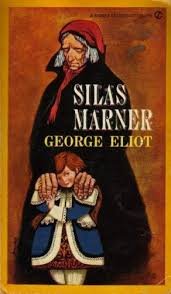
It took me almost 40 years to get around to reading George Eliot, but damn it, I got there in the end. I’ve owned a paperback copy of Silas Marner for maybe half that time, but whenever I went to pick it up something else would catch my eye, until a couple of weeks ago when I needed a new book to bring with me to the Nordik Spa and wanted a paperback small enough to fit in a bathrobe pocket. Perhaps not the ideal reason to choose a book, but you get what you get.
The story has an elegant, almost fairy tale simplicity, and is told in such a fashion, with Eliot maintaining a descriptive distance form her characters. The eponymous Marner is a weaver who lived in a strict religious sect. When framed for robbery by his best friend, he faces exile to a small English town where everyone knows everyone else and outsiders remain outsiders for life. There he sets up a profitable business weaving textiles, accumulating riches that he pores over with rapture at every free moment. He has no real wants and is not saving the money for any purpose, but merely values its accumulation.
The village is ruled over by the aging Squire Cass, whose fortunes will go to his oldest son Dunstan. However, Dunstan is under the thumb of his younger brother Godfrey, who is blackmailing him in exchange for not revealing that he was secretly married to a commoner in another village. Dunstan agrees to let Godfrey sell his prized horse, but Godfrey foolishly gets it killed before he can close the deal. On his way home, he comes across Silas’s cottage and robs him of his gold. Silas, despondent, goes to the town for aid. His loss endears him to the townsfolk, who had previously considered him strange and aloof.
Some time later, Dunstan’s first wife rides to town with the intention of confronting hm with his daughter. However, she dies en route and the daughter finds her way to Silas’s cottage. He takes guardianship of the girl and through parenthood finds peace from the loss of his money.
There is more o the book, but this arc serves as a parable that guides the overall story. Despite its focus, Marner himself can go whole chapters without making an appearance, and much time is spent with the townsfolk, where Eliot sketches a mocking but affectionate picture of small town provincialism.
The prose is very much of its era, with the omniscient narrator often summarizing events rather than describing them. The style can strike the modern reader as didactic and dry, but Eliot observes with a keen eye and breathes life into archetypes. A good book worth reading.
Perhaps I’ll get to Middlemarch by the time I’m 80.