Everyone was always against the Iraq War—now.
From the universal condemnation heaped upon it from right and left, it’s easy to assume that it was Cheney and few other neocon hawks who dragged America back into the gulf against its own volition. In truth, the war was pretty popular at first, enjoying majority support by a comfortable margin. It was only as the blunders compounded—the WMDs that weren’t, the absence of al Qaeda, the bungled debaathification that left a disaffected middle class and provided a key opening to jihadist insurgents—that public opinion soured.
Now, over twenty years post-invasion, it’s hard to find anyone who’ll claim that the war was a good idea, or even admit that they ever supported it (I’d love to see a poll asking respondents of sufficient age whether they supported the Iraq War back in 2003 and compare it with polls from that era. I have a feeling the numbers won’t match).
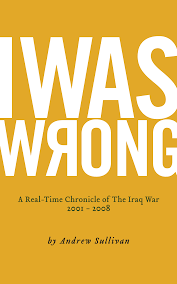
It is thus with refreshing honesty, and even a bit of bravery, that I Was Wrong compiles Andrew Sullivan’s blog posts from that era, laying bare the flawed reasoning and faulty assumptions that made him one of the wars earliest and most vocal boosters, and chronicling his concern, dismay, and ultimate horror at how the war unfolded.
Sullivan never reneges on the core moral argument that impelled him to endorse the war—namely, that Saddam was a monster and deserved ousting—but he is ruthlessly critical of the outcome, and freely admits that, even if a shaky democracy were to eventually emerge from the chaos (which, eventually, it sort of did), it wouldn’t have been worth the chaos and bloodshed unleashed among Iraqis, nor the irreparable damage to America’s vision of itself tarnished forever by Abu Ghraib.
Sullivan is an excellent writer, and I found myself propelled by the prose even as it rehashed old ground in some spots (as blog posts are wont to do). I found Sullivan’s intellectual honesty refreshing, even as his snide dismissal of liberal concerns about the war in the early pages could be grating. Some of his calls were also hilariously bad with the benefit of hindsight—a passage that made me laugh out loud: “ I do think however that this crisis means an obvious shift in terms of Bush’s successor. Two words: Rudy Giuliani”—but his early assessment of Obama as a political force was spot-on.
I was aware of the war as it happened, but didn’t follow it closely, so while I knew the broad strokes, there were details and players that were new to me. I enjoyed learning about it in more depth, but it was also strangely fun to take a brief tour of a period of time that spans my teens and early twenties, reliving stories and events through Sullivan’s scrutinizing lens. The framing of the posts, beginning with the trauma of 9-11 and ending on the eve of the 2008 election with Sullivan’s endorsement of Obama, suggests an optimism that feels undermined by current events, but does offer a through-line that makes it feel more like a book than a simple collection of blog posts.
If you can forgive a man his mistakes—even those with deadly consequences—this book is worth reading.