• The Fever Cabinet
  • Whitetooth Falls
    • Yellow Locust
    • Iron Circle
  • Other Work
  • About the Author
  • Justin Reads
  • Contact
Menu

Justin Joschko

Street Address
City, State, Zip
Phone Number
Author of Yellow Locust

Your Custom Text Here

Justin Joschko

  • The Fever Cabinet
  • Whitetooth Falls
  • Yellow Locust Series
    • Yellow Locust
    • Iron Circle
  • Other Work
  • About the Author
  • Justin Reads
  • Contact

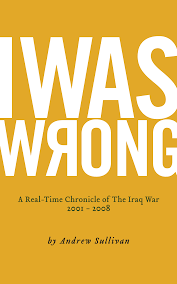
I Was Wrong: A Real-Time Chronicle of the Iraq War 2001-2008 - Andrew Sullivan

April 21, 2026 Justin Joschko

Everyone was always against the Iraq War—now.

From the universal condemnation heaped upon it from right and left, it’s easy to assume that it was Cheney and few other neocon hawks who dragged America back into the gulf against its own volition. In truth, the war was pretty popular at first, enjoying majority support by a comfortable margin. It was only as the blunders compounded—the WMDs that weren’t, the absence of al Qaeda, the bungled debaathification that left a disaffected middle class and provided a key opening to jihadist insurgents—that public opinion soured.

Now, over twenty years post-invasion, it’s hard to find anyone who’ll claim that the war was a good idea, or even admit that they ever supported it (I’d love to see a poll asking respondents of sufficient age whether they supported the Iraq War back in 2003 and compare it with polls from that era. I have a feeling the numbers won’t match).

It is thus with refreshing honesty, and even a bit of bravery, that I Was Wrong compiles Andrew Sullivan’s blog posts from that era, laying bare the flawed reasoning and faulty assumptions that made him one of the wars earliest and most vocal boosters, and chronicling his concern, dismay, and ultimate horror at how the war unfolded.

Sullivan never reneges on the core moral argument that impelled him to endorse the war—namely, that Saddam was a monster and deserved ousting—but he is ruthlessly critical of the outcome, and freely admits that, even if a shaky democracy were to eventually emerge from the chaos (which, eventually, it sort of did), it wouldn’t have been worth the chaos and bloodshed unleashed among Iraqis, nor the irreparable damage to America’s vision of itself tarnished forever by Abu Ghraib.

Sullivan is an excellent writer, and I found myself propelled by the prose even as it rehashed old ground in some spots (as blog posts are wont to do). I found Sullivan’s intellectual honesty refreshing, even as his snide dismissal of liberal concerns about the war in the early pages could be grating. Some of his calls were also hilariously bad with the benefit of hindsight—a passage that made me laugh out loud: “ I do think however that this crisis means an obvious shift in terms of Bush’s successor. Two words: Rudy Giuliani”—but his early assessment of Obama as a political force was spot-on.

I was aware of the war as it happened, but didn’t follow it closely, so while I knew the broad strokes, there were details and players that were new to me. I enjoyed learning about it in more depth, but it was also strangely fun to take a brief tour of a period of time that spans my teens and early twenties, reliving stories and events through Sullivan’s scrutinizing lens. The framing of the posts, beginning with the trauma of 9-11 and ending on the eve of the 2008 election with Sullivan’s endorsement of Obama, suggests an optimism that feels undermined by current events, but does offer a through-line that makes it feel more like a book than a simple collection of blog posts.

If you can forgive a man his mistakes—even those with deadly consequences—this book is worth reading.

Tags I Was Wrong, Andrew Sullivan, Non-fiction, Iraq War, US Politics, 2013

A Woman First: First Woman - Selina Meyer (Billy Kimball and David Mandel)

December 12, 2021 Justin Joschko

Veep is a great show. It’s so good that I couldn’t resist buying A Woman First: First Woman, even though I’m not often one for TV show or movie tie-ins (though I have made exceptions: see The Real Festivus). The book is proported to be an autobiography by former president Selina Meyer, and is presumably distinct from the fictitous Some New Beginnings: Our Next American Journey (though I would happily read that as well). Humour books are tricky, but this one plays very well, with a solid collection of jokes that vary enough in structure to avoid getting formulaic or predictable. It also fleshes out some of the events in the show, which always took the admirable path of hinting at actions rather than dumping exposition in your lap. (I confess that I didn’t fully understand the Uzbek hostage scandal until I read about it here.)

There are some jokes hinting that the entire book was lazily ghostwritten, presumably by Mike McLintock, and the early chapters parsody the optimistic vacuity of most politicians’ books. However, the bulk of the book is presented as an honest recounting of Selina’s life, told from her perspective but without the outright lies that would doubtless obscure any actual publication the character put out. It reads most like a long-winded grievance told to a trusted confident. Selina is arrogant, insulting, and blind to her many defects, but she still tells the story more or less as it probably happened, rather than causing you to glimpse the truth behind veils of falsehood, which is more what I expected.

The voice feels very much like Selina’s, particularly in the final seasons, where her original flaws have metastatized and consumed whatever bit of actual humanity she’d possessed in season 1. Veep and I’m Alan Partridge, two of my favourite shows, were both written by Armando Iannucci, and while there are certainly similarities betwee nthe tow characters—outwardly successful bigheads who are nevertheless deeply unhappy and busting their skulls bloody on the ceilings of their own limitations—I noted in watching Veep that Selina’s flaws deepen, while Alan’s remain more or less flat. Selina in season 1 is a better person than Alan Partridge, but Selina in season 6 is far worse, plummeting past pigheadedness into the depths of clinical sociopathy. I would mark season 4 as the point in which their lines cross on the old Douchometer, though I’d need to rewatch the show carefully to be sure.

Definitely something for fans of the series to pick up,

Tags A Woman First: First Woman, Selina Meyer, Billy Kimball, David Mandel, Fiction, Humour, Fake Autobiography, US Politics, 2019

Trumpocalypse: Restoring American Democracy - David Frum

July 9, 2020 Justin Joschko
Trumpocalypse.jpg

Trumpocalypse: Restoring American Democracy is the clear successor to Trumpocracy, which admittedly I haven't read. However closely it parallels or responds to that book, it is sufficiently self contained to stand on it’s own as an indictment of Trump and a roadmap to a world when he is gone.

The book has two sections. The first itemizes the various cultural factors that led to Trump's election, and describes the consequences of this event for American institutions. The second half offers a more optimistic tone, providing solutions for healing the country culturally and politically. It focuses less on strategies for beating Trunp himself, and more on undoing the fractures left in his wake, crack that he did not cause, but has deepened and widened during his four years in office.

Frum's prose is polished and clear, buoyed by moments of dry humor, but also laser focused on its arguments. He doesn’t waste a lot of time with rhetoric, which serve's the book’s purpose fine. It was a quick and engaging read, the sort of timely book you appreciate but dont necessarily need to come back to time and time again. As a vision for a future United States, I can only hope it comes to fruition.

Tags Trumpocalypse, David Frum, Non-fiction, US Politics, 2020
Comment

The Corrosion of Conservatism - Max Boot

February 16, 2019 Justin Joschko
Corrosion of Conservatism.jpg

I came across this book by happenstance. Chantal had put a hold on it at the library and I picked it up for her. I flipped through a few pages on the way home and ended up reading the whole thing over a couple of days.

I knew Max Boot only through his columns at the Washington Post, which I read regularly. Lately I’ve found my favorite columnists are actually those rare conservatives and former Republicans who have become vocal critics of their former party in the wake of Trump. Folks like Boot, Jennifer Rubin, and Rick Wilson. While I disagree with them on most nuts-and-bolts policy issues, I appreciate their common stance on politics as a means of good governance, rather than a vehicle for seizing power. It’s not easy to speak up to your own team when they’ve gone stray, and I respect Boot and others like him for doing so.

The Corrosion of Conservatism isn’t the sort of book I usually gravitate towards. It’s essentially a platform book, in which Boot lays out what drew him to conservatism and where he feels the movement went wrong. There’s nothing wrong with that sort of thing, but such books usually come across as fairly shallow exercises, the sort of thing people buy for the name on the cover more than the actual content. Boot’s book rises above this level, largely thanks to his experience as a writer of modern history, which he uses to provide context and depth to his arguments.

In the closing section of the book, Boot offers a mea culpa of sorts, in which he highlights the darker side of conservatism that his party affiliation had blinded him to in the past. I’m aware there are hard-liners on the left who find his past stances unforgivable, but from where I stand Boot seems to have done some real soul-searching, and willingly embraced the aspects of progressivism that partisanship alone had previously repelled, without pinballing between extremes—an act that is surprisingly common in politics. There are many stances he holds with which I still disagree, but I think he’s got integrity, and these days you can’t ask for much more than that.

Tags Max Boot, Corrosion of Conservatism, Non-fiction, US Politics, 2018

POWERED BY SQUARESPACE.