• The Fever Cabinet
  • Whitetooth Falls
    • Yellow Locust
    • Iron Circle
  • Other Work
  • About the Author
  • Justin Reads
  • Contact
Menu

Justin Joschko

Street Address
City, State, Zip
Phone Number
Author of Yellow Locust

Your Custom Text Here

Justin Joschko

  • The Fever Cabinet
  • Whitetooth Falls
  • Yellow Locust Series
    • Yellow Locust
    • Iron Circle
  • Other Work
  • About the Author
  • Justin Reads
  • Contact

Orthodoxy - G.K. Chesterton

April 25, 2022 Justin Joschko

I picked up G.K. Chesterton’s celebrated work of Christian apology Orthodoxy hot off the heels of the incredible The Man Who Was Thursday. Orthodoxy is a much different sort of work, which was no surprise, but it thrums with the same gleeful energy. In its pages, Chesterton offers a primer, not for conversion generally, but for his conversion, explaining the many ways that Christianity came to him as the answers to questions he didn’t even quite realize he was asking. The result is the slightly meandering but always amusing meanderings of a fleet mind.

Chesterton positions Christianity almost as an inevitability of thought. His arguments are often well-reasoned, though some of them feel kind of spurious. I was particularly unconvinced by his reasoning that miracles have been proven because they have been reported, and skepticism of these reports comes from intellectual bigotry, and not, say, a perennially unfulfilled request for slightly more evidence. He compares this to a court ignoring eye-witness testimony because the witness was only a peasant, ignoring the fact that in said trial, there is at least the indisputable fact of a dead body to discuss. The skeptic wants to see not only that the miracle was divine, but that it actually happened in the first place.

Nevertheless, Chesterton is a great thinker, and it’s a pleasure to read his thoughts. I can’t say I was converted, but I was certainly entertained.

Tags Orthodoxy, G.K. Chesterton, Non-fiction, Essay, Christianity, Christian Apology, 1908

The Seventies: A Look Ahead at the New Decade - Editors of the National Observer

April 18, 2022 Justin Joschko

Chantal bought this book ages ago at a church bazaar or rummage book sale, mostly as a sort of curio. I finally picked it up and read it the other day. The premise is pretty much spelled out by the title: a collection of essays penned by writers from the National Observer in early 1970, speculating on what was then the coming decade. Each chapter covers a different subject, and the topics are wide-ranging. Space exploration, the economy, politics, foreign policy, the environment each get a chapter, as do perhaps less expected fields, such as oceanography manners. One chapter predicts trends in the arts, and Vietnam, perhaps not surprisingly, gets a look in all to itself as well.

Having been born after the decade under speculation ended, it was interesting to look back at what the writers predicted, seeing where they were wildly off the mark and where they were prescient (sometimes almost eerily so). I could reflect more immediately on some chapters than others, based on my knowledge—it was pretty obvious what came true and what didn’t in the space and Viet Nam chapters, whereas in the medicine and oceanography chapters I could only say vaguely what came true and what didn’t (I know we have submersibles that can operate at 20,000 feet now, but did they begin operation in the 1970s as predicted? I have no idea).

Below, I’ve given a quick summary of what each chapter nailed and what it whiffed on, based on my recollections:

  • Space Exploration: called GPS and satellite imagery, but wildly optimistic on moon colonies (supposed to be in operation by 1979. Oops)

  • The Economy: no wild predictions, basically right on Keynesian Economics avoiding another depression.

  • Medicine: my big takeaway here was how much was still on the horizon in 1970. Organ transplants were in their infancy, as were antidepressants (Lithium was the new big thing). Not sure if they really took off in the seventies, but they were right on the general trend.

  • Foreign policy: more or less on target, except about Japan becoming a regional political power (they nailed it on their economic influence though).

  • Lifestyle: ranging from the insane (see-through body stocking with modesty patches) to the prescient (modular construction to cut down on home costs).

  • Vietnam: Humility in their predictions, as they made it clear they didn’t know, but erred on the optimistic side in assuming South Vietnam stood a chance.

  • The Arts: Another chapter of home runs and strikeouts. Pretty much predicted punk (“In underground music, I think you’ll get a return to root forms, a sort of new classic approach to rock”) but completely wrong on cinema (predicted the doom of major studios and the continued rise of small, meaningful films at the expense of big budget epics. Someone didn’t see Jaws and Star Wars coming, that’s for sure).

  • The environment: focused on pollution ,and right that it would be somewhat curbed. No sight of climate change yet.

  • Oceanography: We didn’t get bubble stations on the ocean floor, sadly. The other stuff seemed more or less right, though I can’t speak to the timeline.

  • Politics: Foresaw the death of the New Deal and the drift of the South, but prematurely buried the two-party system.

  • Education: nascent view of technology in schools.

  • Travel: They were right about trains in the US, that’s for sure.

  • Manners and Mores: Nothing too outré. Saw the slow decline of religiosity.

  • America’s Reputation: This was more about its current reputation than speculating on the future.

Not a bad grade, overall. A few big misses, but the writers were clearly thoughtful in their speculation. Not something I’m likely to reread, but was worth picking up for sure.

Tags The Seventies: A Look Ahead at the New Decade, National Observer, Non-fiction, Predictions, 1970s, American History, 1970

The Haunting of Hill House - Shirley Jackson

April 4, 2022 Justin Joschko

I first read The Haunting of Hill House in a larger collection of Shirley Jackson’s work, and while I enjoyed it, it was overshadowed by We Have Always Lived In the Castle, Jackson’s greatest work and, to my eyes, one of the crowning achievements of 20th century literature. But Hill House really is an excellent book, and I was happy to revisit unhappy Eleanor as she undergoes her strange symbiosis with the eponymous building. For that’s how I always interpreted the book: the house found her and knew her for its own and, through its designs, kept her.

Eleanor is masterfully rendered in this book. Jackson creates remarkable characters, but Eleanor may be her crowning achievement, even more than Merricat Blackwood (though Merricat will always be my favourite). Broken by the toil and slow cruelty of an unhappy childhood cap-stoned by her years as her mother’s nursemaid—details revealed only in secondhand snippets, but precise and vivid enough to undergird a novel all their own—Eleanor tumbles from subservience to her mother to subservience to her sister. A letter from Dr. Montague inviting her to participate in a study of the paranormal gives her a chance to escape, and she snatches it with wild abandon.

In a lesser book, Montague would be the villain, his purposes for drawing disparate characters to Hill House convoluted and sinister. But he is actually a sympathetic man struggling to unite the spiritual and empiricist halves of his mind, a longstanding battle that informs his particular, idiosyncratic fascination with the paranormal. The glamorous Theodora, very much a mirror opposite of Eleanor, is the only other invitee to arrive, apart from Luke Sanderson, nephew of the house’s owner who is foisted off to keep him out of trouble. The fact that he actually doesn’t need such keeping is another detail a lesser writer would have missed.

Jackson’s characters are not broad. They are complex and troubled and hard to pin down. They bounce form camaraderie to conflict with such rapidity that it can feel shocking, but it all feels earned and natural. There are hints that the house may be manipulating them, but the extent of this is never clear. Even the actions of the ghost—if indeed there is a ghost; I tend to think the spirit is the house itself, birthed in trauma, rather than restless human soul—are opaque despite being realized in great detail (the cold spot is a nice touch, and the phantom hand Eleanor holds in an imagined darkness is one of the sharpest scenes in any horror book). Jackson draws few signposts, and the reader can infer to the best of their ability what exactly causes the final tragic events to unfold.

A neat parallel to We Have Always Lived in the Castle is the arrival of Dr. Montague’s wife, whose pigheaded spiritualism clashes with his own more nuanced take, causing a disruption in line with that of Merricat’s cousin in the later book. Their relationship is magnificently rendered, frosty without any of the cliches that mar depictions of martial strife in many other stories.

Shirley Jackson is one of America’s greatest writers. Had she not somehow excelled herself with Castle, Hill House would be her magnum opus. Any author would be proud to have such a book as their best work. The fact it is only number 2 speaks to her tremendous talent.

Tags The Haunting of Hill House, Shirley Jackson, Fiction, Horror, Gothic, 1959

The Man who Was Thursday: A Nightmare - G.K. Chesterton

March 31, 2022 Justin Joschko

G.K. Chesterton was one of those writers whose name I absorbed during University without knowing much about what he actually wrote. I’d heard of him primarily as an essayist and Christian apologist, and was surprised to learn he’d written a novel. After starting The Man Who Was Thursday, I was even more surprised to learn exactly what kind of novel he’d written.

The Man Who Was Thursday is a strange and remarkable work, earnest and funny and rich in philosophical thought. In its surrealism, its humor, its persistent questioning of reality, it it antecedent to everything from Kurt Vonnegut to Franz Kafka to Philip K Dick. I can think of only one author who serves as a clear inspiration, and I like to think Chesterton would agree, for he namechecks the man in the novel (the first of the moles to fall goes by the name Gogol).

The story begins with two poets in the park: the fierce anarchist Gregory and the logical but single-mindedly anti-anarchist Syme. Syme goads Gregory into revealing his anarchist club, at which point Syme reveals himself to be an undercover policeman charged by an unseen man (or perhaps entity is a better word) to root out anarchy. Through manipulation of Gregory, Syme is elected Thursday, one of seven figureheads of a European anarchist cabal led by the enormous and enigmatic Sunday.

One by one, Syme’s fellow figureheads are revealed to be other than they claim, until the whole conspiracy folds in on itself and becomes something of a metaphysical puzzle for its principal members. The ending felt a bit weaker than the rest, settling into convention for a novel that was otherwise totally unconventional, but I’m not sure how such an odd book could end.

Chesterton’s prose is exquisite, whip-smart and hilarious, masterfully contorting ideas into impossible forms that somehow hold firm. More than most authors, his intellect is on plain display in his writing, not because he is showing off, but because it was so fill to bursting in his head that it had to go somewhere, and the page was as good a destination as any.

I’ve already started Orthodoxy and will be reading a lot more of him in the near future.

Tags The Man Who Was Thursday, G.K. Chesterton, Fiction, surrealism, Philosophy, Metaphysics, Mystery, 1908

Shardik - Richard Adams

March 25, 2022 Justin Joschko

A copy of Shardik has sat on my bookshelf for over fifteen years. I bought it as a teenager, fresh off the heels of reading the incomparable Watership Down and further intrigued by the character’s name check in the third Dar Tower book, The Waste Lands. I know I started it shortly after I bought it, but for whatever reason I put it down after fifty r so pages and didn’t pick it up again until a few weeks ago. I can understand why, as it is a long book written in a rich, almost antiquated style, and the plot simmers for quite awhile before flaming up into action. I’d read more challenging books by then, though, so perhaps it caught me when I was craving a breezier read. In any case, it sat unread on my shelf all this time, following me between houses and cities, always earning a place among my other books.

But now I’ve read it, and I can safely say I was missing out. Shardik is a fantastic book, densely woven with complex characters and a world envisioned in such detail that it almost seems real. it is the worldbuilding that aligns it with Watership Down, that and the fundamental optimism of its author, which survives the horrors enacted in both books only to emerge unscathed at the end of each. Otherwise, they are very different novels—so much so that I can’t help but admire the bravery (or thickheadedness) of Adams following up a highly successful children’s book about rabbits with a dense religious parable about the evils of slavery and the unfathomable nature of the divine.

The hero, a simple hunter named Kelderek, is greyer than his leporine counterparts in Watership. He starts out with a simple nobility that reminds me of Fiver, but Adams allows for his corruption when given the sacred role of envoy to Shardik, the bear god long worshipped on his home island of Ortelga but unseen for generations, until the chance arrival of an enormous bear driven ashore by a forest fire. Shardik has a rich cast, but Kelderek is its core, and Adams makes the bold choice of making him compromised by his decisions, breaking him down in the third act in a saintly scouring that allows him to reemerge, literally and figuratively cleansed.

Adams’ writing remains superb, deftly outlining the geography, history, and politics of the Bekla and the surrounding regions. His prose is strong, though in this book he has a tendency to use extended similes, in which a scenario is depicted in great detail—sometimes for whole paragraphs—then compared to the current action. As a device, it harkens back to classical texts, and gives the writing an air of antiquity, but there are periods where it feels somewhat repetitive, being employed over and over again in quick succession.

This is a small matter, though, and doesn’t detract form the book’s overall power. It deserves to be ranked among the great 20th century novels.

Tags Shardik, Richard Adams, Fiction, Fantasy, 1974

The Satanic Verses - Salman Rushdie

February 28, 2022 Justin Joschko

The Satanic Verses is one of those books more famous for the events surrounding it than for the text itself. I don’t have much to say about that side of things, as I think the events of the fatwa are pretty well known. What I didn’t know was what exactly it was about the book that aroused such ire. Having now read the whole thing, my impression is that Rushdie touched a nerve primarily by writing about Muhammed (or Mahound as he’s rendered in the book, which was apparently insulting as well) as a man with vested interests in his own divine inspiration, and by expressing ambiguity regarding the truth of his revelations. Yet while these discussions could potentially insult muslim readers, there is nothing in the book overtly designed to offend, and, as is the case with most controversial books, the controversy likely arose mostly from people who had never read the book and had only the roughest, least charitable impression of what was in it. So it goes.

The book is all over the place in the usual Rushdie style, but the story, insofar as it sticks ot one, revolves around two Indian citizens of muslim backgrounds, Gibreel Farishta and Saladin Chamcha, who miraculously survive an explosion in an airplane over London and are imbued by divine and infernal avatars, respectively. Gibreel adopts the holy visions of his angelic namesake, while Saladin grows the horns and cloven hoofs of a demon. Having described these startling events, the narrative promptly swerves in a dozen other directions, leaping backwards to the founding of Islam or describing a bizarre pilgrimage to the Arabian Sea led by a prophetic young girl clad in butterflies. Rich images abound, plot is thin on the ground, and diversion are plentiful. Things do eventually swing back around to Saladin and Gibreel, but never in the way you expect (Saladin’s cursed form disappears abruptly with little explanation and never bothers him again).

Rushdie’s prose is verbose and playful, full of puns and references and crackling images. It can be a little much at times, but his gift for language is indisputable, and he’s a lot of fun to read when he’s not exhausting you with 26 zigzagging sub-clauses in a row.

Having read only this and Midnight’s Children, I can’t claim to be a Rushdie scholar. However, there are clear parallels between the two books that suggest possible preoccupations common to his work: the entwining of the supernatural and the mundane; a deep drawing on history, particularly that of his country and his faith; main characters endowed by circumstances with powers that are both blessing and curse; a twinning of protagonist and antagonist.

There is also something about the way he writes women that struck me in both books. He by no means falls into the typical traps of lesser male authors writing women. They are neither passive objects of rescue nor empty vessels of desire. They are strong and capable, but also strangely cold. They seem less human than deity, and imbued with a cruelty that is not mortal but divine. It’s not a personal, vicious cruelty, but a sort of dry pitilessness. They seem always composed, never weak or vulnerable, and the violence men try to visit upon them is as pointless as fists on stone. There are certainly exceptions to this—most notably Alleluia Cone—and you could point to moments that contradict this impression for most of his other female characters as well. The general impression, however, remains. His women seem just a little farther removed from the reader than his men.

Tags The Satanic Verses, Salman Rushdie, Fiction, India, Islam, literary fiction

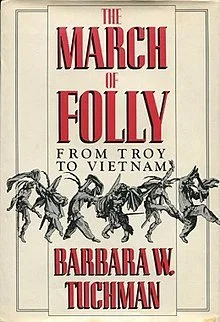
The March of Folly: From Troy to Vietnam - Barbara Tuchman

February 16, 2022 Justin Joschko

History is a study of patterns. Good historians don’t simply chronicle the past; they study the echoes of events and their resonance in other eras before and after. Such is the central mission of The March of Folly, in which Barbara Tuchman parses Western history in search of a recurring theme, which she calls folly. Simply defined, folly is an action undertaken by a government in which it pursues actions contrary to its own interests. Folly must be recognizable at the time, have no conceivable benefit and great costs.

Tuchman opens her book with a few quick snapshots of folly—the Spanish loss of Iberia to the Moors, the acquiescence of Montezuma and the Aztecs to Cortes, the German attacking of American ships in World War 1, the Japanese bombing of Pearl Harbor in World War 2—which she uses to lay out her premise and familiarize the reader. The bulk of the text, however, is dedicated to four distinct events: The fall of Troy, the loss of half of Christendom to the Renaissance popes, the British stoking of the American Revolution, and the America debacle in Vietnam.

Troy is an interesting choice of antecedent, given that it is more myth than history. Tuchman makes no effort to parse truth from fiction, freely recounting the actions of gods in her summary. She instead uses Troy to demonstrate how deeply folly is imbedded in the human psyche, and pulls out key components than will resonate in future eras (for instance, the ignored warning of poor Cassandra).

The other three sections follow a similar pattern, providing details descriptions of the prevailing attitudes and responses to events and explaining how they went contrary to the government’s interests. A certain level of knowledge is assumed, and key events (The 95 Theses and Diet of Worms, the Boston Massacre, the Tet Offensive) are spoken of without much description. Clearly Tuchman’s target audience had a certain level of historical fluency (I’m pleased to note there wasn’t very much I needed to look up). The history presented is very much a history of policy, examining the undergirding structures that addressed—or, often, exacerbated—major events.

Tuchman’s writing is solid, academic without being too dry. She sometimes goes a little overboard with subordinate clauses, making sentences into grammatical Matryoshka dolls, but overall she is very readable considering the heft of the subject matter. I wouldn’t rate March of Folly quite as high as The Guns of August, which remains a seminal book on the history of World War One. But it’s well-written and compellingly argued, and worth checking out for those interested in how human folly shapes history.

Tags The March of Folly, Barbara Tuchman, Non-fiction, History, Western History, Greek Mythology, Middle Ages, American Revolution, Vietnam War, 1984

Bury My Heart at Wounded Knee: An Indian History of the American West - Dee Brown

February 8, 2022 Justin Joschko

Bury My Heart at Wounded Knee was a title I’d always heard without knowing much of its contents. Its connection with American Indians was obvious from context, but whether it was a film or a novel or what I didn’t know. As it happens, the book is a historical chronicling of America’s western expansion in the second half of the nineteenth century, told entirely from the perspective of the tribes that were displaced or destroyed. It is a sad book, sympathetically told, and an important one, in that it collects the words and recollections of a people who were rarely allowed t ospeak for themselves—certainly not in as wide a forum.

There is a depressing repetitiveness to the book, which proceeds chronologically forward and, for the most part, geographically westward. In each chapter we meet (or occasionally revisit) a tribe, and watch as the same cycle repeats itself: pressure fro mwhite settlers forces the indians to accept some sort of treaty. The treaty is either a swindle from the outset, or bargained in good faith but reinterpretted later to be more beneficial to the United States government and less to the tribe. Tensions rise until the tribe is corralled into a reservation or goes to war with an enemy it cannot beat. Tactical intelligence sometimes brings brief victories, legal or martial, but the tide is inexorable, and it sweeps always west.

Though unflinching in its portrayal of history, this is not a bitter book. There are good white men who see the Indians as human beings and want to do right by them, and cynical tribes who ally with the American soldiers against other Indians in order to secure better terms for themselves. Yet individual goodness cannot perservere against an unfeeling system, and those who attempt to resist are either worn down into apathy or destroyed. In this sense it reminds me a bit of The Wire, a more modern example of flawed but good people bashing their heads against an unfeeling system in an effort to budge it an inch, and coming away with nothing for their troubles but pain.

Brown’s writing is strong and crisp, capturing some of the poetry of the men for which it speaks. Long passages are sometimes quoted which give particular evidence to the lyrical nature of native tongues, rich in metaphor and anchored closely to the land. I wouldn’t call Bury my Heart a light read, but it is an engaging and important one.

Tags Bury My Heart at Wounded Knee, Dee Brown, non-fiction, american history, Indigenous Populations, 19th Century, American West, 1970

Noble Savages: My Life Among Two Dangerous Tribes—the Yanomamö and the Anthropologists - Napoleon Chagnon

January 28, 2022 Justin Joschko

Noble Savages is another book scooped from my wife’s collection of library checkouts. I read it on her recommendation, and didn’t know anything about the subject matter before picking it up. The book is a memoir by cultural anthropologist Napoleon Chagnon, a man I’d never heard of but who was apparently the main flashpoint of a controversy that tore the discipline into two camps: those who view anthropology as a fundamentally scientific pursuit in alignment with biological principles, and those who view it as one of the humanities with a mandate principally to identify and right the wrongs of past colonial encounters with native populations. Chagnon is staunchly a member of the first group, a leaning that is alluded to often throughout the book and becomes the central issue in its final chapters.

But despite being a memoir, the book isn’t as much about Chagnon as about the principal subjects of his decades-long research career: an Amazonian tribe called the Yanomamö, who were at the outset of his fieldwork in the late 60s among the last of the human tribes that could reasonably be called “untouched by civilization.” They had encountered the modern world, of course, but such encounters were fleeting, and their way of life remained as it had been for thousands of years before.

Chagnon describes his first encounter in detail, but much of the book takes a non-chronological approach, focusing instead on different aspects of Yanomamö culture as an organizational principle. After a lifetime of writing academic works, Chagnon seems incapable or unwilling to deviate from his observational stance, which makes it a bit unusual as a memoir, though also makes it more interesting overall to someone unfamiliar with the Yanomamö. His respect for them as a people is clear, and while he does not hesitate to point out their foibles, he does so in a way that acknowledges their full humanity. This stance seems to implicitly argue that kid gloves approach of his opponents, who see the West as the aggressor and native tribes as fundamentally innocent, is an infantilizing and ultimately prejudiced viewpoint, denying the Yanomamö the full gamut of human traits, good and bad.

Its final chapters shift to his life after his research was curtailed by interference from local missionaries, who he claims saw him as a threat to their dominance, and pressure from rival academics, culminating in a hatchet job book that appears at this point to have been largely discredited. His bitterness is apparent but understandable. I have studied only his side in detail, but his arguments are convincing, and the bit of reading outside I did seems to confirm the perspective that the was wrongly accused of unethical conduct. His true sin seems to have been his unwavering conviction that Yanomamö follow biological imperative, and that basic biological drives—procreation, namely—drive their conflict more than scarce access to resources, which is the Marxist perspective.

All in all, an interesting book. I don’t think I’ll necessarily get out his other, more academic work, but i greatly enjoyed learning about the Yanomamö.

Tags Noble Savages, Napoleon Chagnon, non-fiction, Anthropology, Indigenous Populations, Memoir, 2013

Into Thin Air - Jon Krakauer

January 10, 2022 Justin Joschko

I’d read a couple of Jon Krakauer’s books already, most notably the excellent Into the Wild, but I didn’t feel much interest in reading Into Thin Air, I guess because mountain climbing doesn’t strike me as terribly interesting. My wife raved about the book, though, and when she brought it back from a neighbourhood Little Free Library I decided to give it a shot.

I’m glad I did. The story is well-written and compelling, as it chronicles a disastrous expedition to summit Mount Everest in the spring of 1996. Krakauer frames the story expertly, beginning with the momentary triumph and a brief portent of things to come, before backing up on the circumstances that led to his joining the expedition, the preparation, and the multi-stage ascent. He weaves in background to give the story greater context, giving the history of the mountain’s discovery by western surveyors (locals knew it long before, of course), the early aborted attempts at the summit, and Edmund Hillary’s 1953 triumph.

With the groundwork laid, the story builds towards the seemingly inevitable tragedy, as Krakauer chronicles with clinical efficiency the dozens of tiny failings (including his own), missteps, and unfortunate circumstances that cuminated in one of the worst single-day disasters in the mountain’s bloody history. A post-script discusses the controversy that emerged in the book’s aftermath, and dismantles some of the claims made against its accuracy. I haven’t read the counterpoint, but Krakauer’s rebuttals are convincing, and it certainly seems that his breadth of after the fact interviews was much greater than those of his detractor.

Krakauer’s prose is elevated but visceral, painting a clear picture of the prolonged misery of trying to climb the world’s highest mountain. I obviously never thought it would be easy, but wha tsurprised me was the time committment involved. I didn’t know that simply reaching the summit required nearly a month of acclimatization efforts simply to ensure you didn’t drop dead once you passed 28,000 feet. Doesn’t seem worth it to me, frankly, but I guess it takes all kinds. I’ll stick to reading about it afterwards.

Tags Into Thin Air, Jon Krakauer, non-fiction, Adventure, Mountain Climbing, Disaster, 1997

Foundation and Empire - Isaac Asimov

January 10, 2022 Justin Joschko

Second in the Foundation series, Foundation and Empire feels more like a discrete story than the original, which was comprised of numerous shorter works stitched into a larger narrative. Empire is still not a single story, however, but two. The first story, speaking most directly to the book's title, concerns the last gasp of the first Galactic Empire as an ambitious general sets his sights on Terminus, the home planet of the first foundation. The story plays out much like those from the original book, where a wise and level-headed protagonist shepherds through the successful unfolding of Seldon's plan.

It is the second and longer story of the book, The Mule, where things get more interesting, for it is here where the Seldon prophecy appears, finally, to break down. The cause of this breakdown is the eponymous Mule, an enigmatic warlord with mutant powers to great and specific to be detected by the broader sweep of Seldon's psycho psychohistory. The story thus plays out more like a mystery, as hidden forces pull at the husband and wife protagonists, dragging them into the maelstrom of galactic conquest and goading them to seek Foundation's salvation from its would-be conqueror.

The prose remains vintage Asimov, though feels a bit more refined than that of the first book, perhaps because the stories themselves were more comprehensively planned. As always, it’s the ideas themselves that sparkle, the words and characters serving mainly as vessels.

Tags Foundation and Empire, Isaac Asimov, Science fiction, Foundation Series, 1952

Foundation - Isaac Asimov

December 23, 2021 Justin Joschko

It’s been a long time since I last read Foundation. I picked up the series back in high school and was entranced, burnign through the four novels I thought comprised the complete series in a matter of months (there was actually a fifth book already published at the time, but it wasn’t around when the collection my dad had was printed, so I was unaware of it until recently). I recalled the overall premise very clearly, and could visualize a few key scenes, but much of the details escaped me, which gave rereading the first book a nice sense of rediscovery.

The premise, put briefly, is this: a mathematician named Hari Seldon uses a new branch of science called psychohistory to predict future events with great accuracy. He deduces that the Galactic Empire in which he resides will collapse in a matter of centuries, leaving in its wake thirty thousand years of barbarism and savage warfare. Such an event cannot be stopped, but its intensity and duration can be curbed through the preservation of knowledge that will otherwise be lost in the calamity. To this end, he creates his Foundation, two planet-sized organizations on opposite ends of the galaxy, charged with sheltering the galaxy’s scientific and philosophic treasures for a millenia before ushering in a new golden age 29,000 years ahead of schedule.

Seldon is the most recognizable character in the series, but he’s far fro mthe most prominent, considering he is dead for all but the first couple dozen pages. Indeed, the substantial timescale of the story means that no one protagonist sticks around for long; the first book alone has three protagonists over its 150-year span (excluding the first chapter, in which Seldon himself qualifies as protagonist). These are Salvor Hardin, a crafty politician and the first true ruler of Terminus; Limmar Ponyets, a shrewd trader; and Hober Mallow, a merchant who sees the key role commerce can play in the Foundation’s survival.

The jump between characters is not particularly jarring, because in all honesty they aren’t particularly different. Each is an intelligent and percpetive skeptic who uses reason and a keen understanding of human psychology to think his way through a “Seldon Crisis,” defined as a key inflection point in history that Seldon had predicted in his calculations. None of Asimov’s characters are particularly complex, though they have enough humanitry in them to make you root for the good guys and take pleasure in the downfall of the bad guys.

The writing, like the characters, is servicable but not particularly inspired. I had read a lot less when i first encountered these books, and I was surprised at how plain the prose is. Still, Asimov is an able craftsman ,and while ther language doesn’t sing, it hums along nicely, and clearly conveys the story, which is his true strength.

Novels have three legs: story, characters, and language. Generally, a book can be good with only one, but needs at least tw oto be great. However, Asimov performs a feat by writing a great book with only one leg to stand on. His power of imagination, and the richness of his ideas, are enough to carry Foundation even while the language and characters are nothing special. I look forward to picking the next in the series back up, and plan to buy the fifth and finally learn what happens.

Tags Foundation, Isaac Asimov, Science fiction, Foundation Series, 1951

The Berlin Stories - Christopher isherwood

December 14, 2021 Justin Joschko

This is a hard one to categorize. The Berlin Stories is a collection of two previously published novellas, Mr Norris Changes Trains and Goodbye to Berlin, the latter of which is itself a collection of smaller stories surrounding, and closely related to, the principal novella, Sally Bowles. Despite this slightly hodgepodge origin, the book works as a thematic whole, and could in its way be construed as a single episodic novel with a consistent narrator, albeit one who changes names midway through. For Mr. Norris Changes Trains is narrrated by one William Bradshaw, a clear standin for the author, whereas the stories of Goodbye to Berlin discard the pseudonymic pretense and are simply narrated by Isherwood. There is even a character who appears in both books—the landlady, Frl Schoeder—offering further continuity.

Despite the name swap, there is no real difference in behaviour or voice between Bradshaw and Isherwood. They are effectively the same character, and both books have a very similar flavour, dealing as they do with misfits in the simultanerously glamorous and squalid Berlin of the late 1920s and early 1930s. Politics plays a part, but it is largely relegated to the background, despite isherwood (sorry, Bradshaw) and many other characters being closely involved with the German Communist party. The real focus instead is on the people, largely outsiders, with strange jobs and stranger hobbies, orbiting on the outer ridges of Berlin society. Many are apparently based on real people—including Mr. Norris and Sally Bowles, the standout pedestal protagonists of Trains and Goodbye, respectively. What their attitudes were to being so intimately captured in prose, I’m not sure.

Isherwood’s writing is superb, rich and elegant, evokative without being too showy. He has a way of capturing minute, superficial details in people that brings out something deeper from them—Sally’s nails, Norris’ teeth. I would be interested in reading his other works at some point.

Incidentally, I struggled whether to classify this as fiction or non-fiction. The works are clearly presented as novels, but based as they are on real people and event,s you could make an argument either way. In the end, I chose to call it fiction, for the simple reason that Isherwood catalogued it as such. Plus, it reads more like a novel, regardless of how much if any of it was invented.

Tags The Berlin Stories, Christopher Isherwood, Fiction, Germany, 1930s, Interwar Period, 1945, Nazi Germany

A Woman First: First Woman - Selina Meyer (Billy Kimball and David Mandel)

December 12, 2021 Justin Joschko

Veep is a great show. It’s so good that I couldn’t resist buying A Woman First: First Woman, even though I’m not often one for TV show or movie tie-ins (though I have made exceptions: see The Real Festivus). The book is proported to be an autobiography by former president Selina Meyer, and is presumably distinct from the fictitous Some New Beginnings: Our Next American Journey (though I would happily read that as well). Humour books are tricky, but this one plays very well, with a solid collection of jokes that vary enough in structure to avoid getting formulaic or predictable. It also fleshes out some of the events in the show, which always took the admirable path of hinting at actions rather than dumping exposition in your lap. (I confess that I didn’t fully understand the Uzbek hostage scandal until I read about it here.)

There are some jokes hinting that the entire book was lazily ghostwritten, presumably by Mike McLintock, and the early chapters parsody the optimistic vacuity of most politicians’ books. However, the bulk of the book is presented as an honest recounting of Selina’s life, told from her perspective but without the outright lies that would doubtless obscure any actual publication the character put out. It reads most like a long-winded grievance told to a trusted confident. Selina is arrogant, insulting, and blind to her many defects, but she still tells the story more or less as it probably happened, rather than causing you to glimpse the truth behind veils of falsehood, which is more what I expected.

The voice feels very much like Selina’s, particularly in the final seasons, where her original flaws have metastatized and consumed whatever bit of actual humanity she’d possessed in season 1. Veep and I’m Alan Partridge, two of my favourite shows, were both written by Armando Iannucci, and while there are certainly similarities betwee nthe tow characters—outwardly successful bigheads who are nevertheless deeply unhappy and busting their skulls bloody on the ceilings of their own limitations—I noted in watching Veep that Selina’s flaws deepen, while Alan’s remain more or less flat. Selina in season 1 is a better person than Alan Partridge, but Selina in season 6 is far worse, plummeting past pigheadedness into the depths of clinical sociopathy. I would mark season 4 as the point in which their lines cross on the old Douchometer, though I’d need to rewatch the show carefully to be sure.

Definitely something for fans of the series to pick up,

Tags A Woman First: First Woman, Selina Meyer, Billy Kimball, David Mandel, Fiction, Humour, Fake Autobiography, US Politics, 2019

Le Petit Hébert - Chantal Hébert

November 29, 2021 Justin Joschko

Le Petit Hébert collects a series of essays that Chantal Hébert published in the Quebec-based magazine L’actualité between 2008 and 2015 (or thereabouts; could go a bit earlier). About two-thirds of the book is divided into four sections, one for each of the four major political parties (Cons, Libs, NDP and the Bloc—sorry, Greens). In these, she gives something of an abridged and selected history, offering essays that highlight the challenges and travails each faced in the years between Stephen Harper forming government in 2008 and Justin Trudeau dethroning him in 2015. The rest of the book comprises a fifth section that could be called “misc,” which collects a range of essays on other topics pertaining to Canadian politics, particularly as it affects Quebec.

Though billed as something of a Canadian politics primer (the subtitle is “La Politique Canadienne Expliquée a mon voisin,“ or “Canadian politics explained to my neighbour”), there doesn’t seem to be any explanatory text added, nor are there definitions outside of what would have appeared in the original articles, whose target audience doubtless already had at least a passing familiarity with the issues of the day. Said audience was also Quebecois, and every story is viewed through that prism (I’d be very surprised if this was ever translated into English).

Hébert is a seasoned reporter with a strong, eloquent style, though her love of idioms makes some passages difficult to understand not only for those not fluent in french, but also those not familiar with Quebec expressions (any idea what it means to be “between the tree and the bark”? Neither does my wife, and she’s as bilingual as they come). Still, the book charted nicely with the period of time in whcih I started following politics, and it was interesting to read about events I recall with the added analysts of an expert in Canadian politics. It’s worth a read if that’s your thing (and if you understand French).

Tags Le petit Hébert, Chantal Hébert, Non-fiction, Canadian Politics, Canada, Francais, 2015

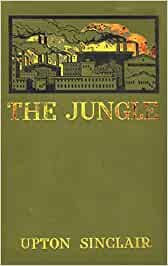
The Jungle - Upton Sinclair

November 15, 2021 Justin Joschko

The Jungle is one of those books I’d heard spoken of for years. For some reason, I’d always thought it was a journalistic account of Chicago’s meat-packing industry. However, it’s actually a novel, and while it is allegedly supported by accounts from Upton Sinclair’s stint working undercover in a meat-packing plant, it is nevertheless wholly fictional.

The story concerns a Lithuanian family who immigrates to America at the turn fo the 20th century. At the center of the story is Jurgis Rudkus, a large and preternaturally strong man who begins with an idealized vision of the New World and his place in it. Slowly, through a series of misfortunes exacernbated by the callousness of the industry and the peripheral figures who prey on its victims—for instance, a duplicitous realtor who sells them a house with strings attached—the family is ground down by capitalism.

Jurgis, beaten by fate, becomes a tramp before returning and wheedling his way into the political machinery of the city. Here he lives a large but vacuous existence that crumbles due to long-simmering avarice. At his lowet, he discovers socialism, and ends the book a devoted convert. The last chapters barely concern him at all, but are instead verbatim speeched from impassioned socialists, and a recounting of the 1904 election where socialists performed well, with an ecstatci prophecy of coming victory.

It will come as no surprise to readers that Sinclair was himself a socialist, and saw the book as a way to demonstrate the inherent evils of capitalism, and the potential salvation offered by his ideaology. Apart from the strident, almost non-sequitor ending, I didn’t find the moral too imposing on the story. Jurgis seemed like a real man, and his struggle,s while intense, were believable. Life really was brutal for working class people at the time, and while Sinclair’s heart is unquestionably on his sleeve, I wouldn’t accuse him of exaggerating anything ,for the simple reason that he didn’t have to.

Sinclair’s prose is crisp and of its era, easy to read and lively without being too florid. I suspect I’d find the book harder to take if I was less in sympathy with his outlook, but whatever your politics, he can clearly write a novel. I’d be interested to read some of his other work

Tags The Jungle, Upton Sinclair, Fiction, Socialism, Capitalism, American Literature, 1906

If it Bleeds - Stephen King

November 2, 2021 Justin Joschko

For a writer famous (or infamous, depending on who you ask) for penning novels with four digit page numbers, Stephen King has always been remarkably good at novellas. If It Bleeds collects four of them, all previously unpublished. They’re a diverse lot, but consistent in quality, and in a broader theme of morality and hard decisions.

Mr Harrigan’s Phone is classic King, and of the four feels the most like one of his old short stories—tales where an ordinary person brushes up against dark forces he can’t quite understand, and backs away form them unbroken but changed. king metes out tough justice, which I’ve always appreciated, and you can’t help rooting for Harrigan even if, as the narrator does, you feel a little ill at ease with the consequences of his powers.

The Life of Chuck is, arguably, the most experimental story King has ever written, and a good rebuff to critics who brush off his writing as lackign literary merit. I’ve always pushed back at this assumption, as King, while no stranger to the potboiler plot, writes real people, not cardboard cutouts, and rich themes invaraibly thrum beneath the pulpy action on the surface of the page. Here those themes are given more spotlight, but still anchored enough to character to avoid feeling showy, as if it were some vanity project to prove his literary chops. The plot is hard to describe—its actually more like three different, each humming their own note to make a sad, autumnal chord—but gets to the notion that there is in each of us a world, perhaps a universe.

If It Bleeds steals the show, as was obviously intended—the collection’s not called Life of Chuck, after all—thanks to the welcome presense of Holly Gibney. With Castle Rock, Giliead, and the dark townships of Derry largely pushed aside, King has very ably built a new world through hir David Hodge novels, which have spilled beyond the initial trilogy into other works, notably The Outsider. This story plays as a kind of sequel to that one, with another shapechanger on the loose, which Holly must track down and destroy. The action is slow to build, giving the story lots of breathing room where King can show his strengths in building relationships between characters. It has always bee nthese, more than fantastic creatures or outrageous landscapes, that have formed the firmest foundation of King’s worlds.

Rat finishes the collection. It’s another troubled writer story, and while this is not my favourite King mode, I must admit this story held me with its excellent use of mood. Doom builds like a fever before breaking in a turn of events that it both jarring and graceful, offering a glimpse into King’s assessment of the creative process, and the old notion of writers as mediums for a distant and ghostly place, where spirits give gifts that always have strings attached. And at least this time we’re granted a semi-supernatural reason why every King character farts out bestsellers.

A solid collection, and evidence of King in top form.

Tags If It Bleeds, Stephen King, Fiction, Horror, 2020

The Corpse Walker: Real-Life Stories, China from the Bottom Up - Liao Yiwu

October 25, 2021 Justin Joschko

I can’t remember where or why I came across this The Corpse Walker, except that I was in an oral history mood and wanted to read something about China. Still, I was sufficiently unclear that when it first came in and I saw the title without the sub-title on my Holds list, I assumed it was a novel I didn’t recall requesting.

The Corpse Walker is no novel, but some of the stories are strange enough to populate one. A long-time dissident and activist in his native land, Liao Yiwu fills this book with conversations he’s had with a wide range of Chinese citizens, from beggars to counterrevolutionaries and former Red Guards to human traffickers. The sole thread uniting the subjects of his book is their status as outcasts or peripheral figures, individuals who dwell on the lowest rungs of China’s social ladder.

Other themes ripple across stories, as well, commonly injustices enacted by the Communist regime, abject failures of the legal system, and witch hunt hysteria against Rightists that made scapegoats of anyone unlucky enough to stand out even briefly. The book is not a history text, and assumes a certain level of familiarity of the reader, but nonetheless it provided a good primer on some of the mainstays of 20th century Chinese history: the Great Leap Forward, the sixties thaw, the Cultural Revolution, the One Child Policy, the Tiananmen Square Massacre. The tight focus of individual accounts lends an urgency to the telling, allowing some of the finer facets of these brutal events or policies to shine brighter.

Yiwu also allows glimpses of pre-Communist China, which seap through in the practices suprressed by the governtment: professional mourning, Feng Shui, Erhu playing and music generally, Falun Gong (actually a recent phenomenon, but harkening to an earlier age). I finished the book with a better appreciation of life in China beyond the basic stereotypes, and while I’m no expert, Liwu’s accounts gave me a glimpse I wouldn’t otherwise have managed.

The books can be classified as oral history, but Liwu actually handles them more like straight-ahead interviews, including his own prompts and reactions in the text and carrying on conversations with his subjects. Unlike a typical journalist, he makes no effort to hide his feelings, betraying indignation on behalf of injustices, and disgust with those he thinks have behaved poorly. Such subjectivity wouldn’t fly in standard journalism, but it works well here, since everything is coloured with a tinge of uncertainty. Subjects recount superstition as fact, and s omany of the tales are such blatant hard luck stories, it makes you wonder if they are shading events in their favour a bit. What’s more, Liwu didn’t generally have access to a tape recorder, and was unable always even to take notes, so all conversations are only approximations of what really occurred. Still, I believe what is written in broad strokes.

Liwu has won international accolades for his writing, but I don’t feel I can comment, since the book is almost entirely transcripts of conversations, which isn’t a proper venue for judging prose. Still, he is perfomring important work, and is undoubtedly fearless in the face of oppression. I’ll look out for more of his work, where he is able to express himself in his own words.

Tags The Corpse Walker, Liao Yiwu, Non-fiction, Oral History, Chinese, China, Communism, 2008

The Only Plane in the Sky: An Oral History of 9/11 - Garrett Graff

October 15, 2021 Justin Joschko

I came across mention of Garrett Graff’s The Only Plane in the Sky in a Guardian article discussing books that explored different stages of 9/11 and its aftermath. The list also included the Looming Tower, which I’d read a bit befor,e so it caught my interest, and as I’m a fan of oral histories, I thought I’d give this one a try as well.

Graff builds his narrative using a chorus-like approach, providing snippets of conversations about a similar topic that build on each other, rather than the extended transcripts of discrete conversations favored by Studs Terkel. Context is provided in italics at times, but by far the majority of the text allows participants to speak for themselves, offering a range of viewpoints that includes office workers in the Twin Towers ,the loved ones of the deceased, government officials on the ground scrambling to understand the situation, first responders, and the cadre surrounding the president in the critical hours of the mornign and early afternoon, as he sought to find a safe place to reassure the nation.

There’s not much to say about the writing, considering it is all transcripts, but the book is well-constructed and remains coheren in its narratives, though the individual stories can get a bit murky as we jump back and forth between participants. The overall picture was quite clear, however. This book is an important piece of history and a chronicle of events that feels very immediate. It can be harrowing at times, but is worth a read for those of us who remember the day as distant observers.

Tags The Only Plane in the Sky, Garrett Graff, Non-fiction, Oral History, 9/11, 2019

Sapiens: A Brief History of Humankind - Yuval Noah Harari

September 30, 2021 Justin Joschko
Sapiens.jpg

I put a hold on Sapiens: A Brief History of Human Kind about half a year ago, after reading the first few pages of my father-in-law’s copy. Based on that sampling, I’d assumed the book was a work of popular anthropology, and would focus on the rise of Sapiens alongside the other Homo species alive in prehistoric times.

It turns out that is only the first chapter.

Sapiens is, in fact, a much broader and more ambitious book than I’d expected. Its goal is no less than to present an encapluated history of the whole of humanity, describing a few touchstone events, but focusing at its core of the nature of what a human first was ,what it is now, and what it might one day become.

I’ve read that academics have criticized the book as unserious and lightly sourced. There is some truth to this, but Sapiens doesn’t present itself as a detailed accounting of human history—how could it? there’s an awful lot of it for one book—but instead invites the reader to question a lot of basic assumptions about what humans are, and how they have become the dominant species on earth. One part I found particularly interesting was his suggestion of why Europe, and not the economically and numerically superior China, went on to conquer the world through empire (he suggests it was the scientific revolution, which was underpinned by the European midset that huamn knowledge is incomplete, and the shift to capitalist doctrine that celebrated growth).

Perhaps the most enjoyable aspect of the book is that Harari’s writing is in no way strident. He sees humanity neither as a divine being nor pestilential evil. He simply recounts things as the yhappened, and draws no moral conclusions (with the slight exception of animal rights, where he shows his cards a bit).

One critic likened the book to dorm room chatter, and while I can see where he’s coming from, this is chatter form a very bright student indeed. Sapiens is well-written and it made me think. I can’t as kfor much more than that in a non-fiction book.

Tags Sapiens: A Brief History of Humankind, Yuval Noah Harari, non-fiction, Popular science, History, Anthropology, Philosophy
← Newer Posts Older Posts →

POWERED BY SQUARESPACE.